
Transforming the Connection to the Deceased Loved One by Roger M. Solomon; published January 30, 2024, by Oxford University Press (Part 1)
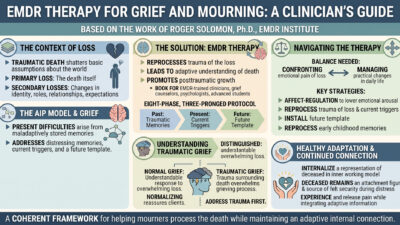
For many, the death of a loved one is a traumatic event that can shatter basic assumptions about the world and their role in it. The death itself is considered a primary loss, while changes in identity, roles, relationships, and expectations may be experienced as secondary losses. Research suggests that EMDR therapy can be effective in treating grief. Reprocessing the trauma of the loss may lead to a more adaptive understanding of death and, at times, to post-traumatic growth.
Roger Solomon is a clinical psychologist and senior faculty member at the EMDR Institute who specializes in grief and trauma. In EMDR Therapy Treatment for Grief and Mourning, he explains how EMDR can help clients cope with grief. Because the book assumes a working knowledge of EMDR terminology and procedures, it is best suited to EMDR-trained clinicians, including grief counselors and psychologists, as well as advanced clinical students.
Solomon applies the Adaptive Information Processing model to theories of grief. EMDR is an evidence-based treatment that follows an eight-phase, three-pronged protocol. According to the AIP model, present difficulties may arise from memories that have been stored maladaptively. Treatment therefore addresses the distressing and traumatic memories underlying present problems, current triggers, and a future template for responding adaptively to each trigger. Solomon also recommends identifying and reprocessing negative memories and negative beliefs involving the loved one. This work may help mourners develop a more adaptive perspective on the relationship, integrate painful memories, and experience greater post-traumatic growth.
Within this framework, therapy must address both the emotional impact of the loss and its effects on the mourner’s daily life. Mourners may need to move back and forth between confronting the emotional pain of the loss and managing the practical changes it creates. Affect-regulation strategies can lower emotional arousal; when mourners are ready, they can process the trauma of the loss, address present triggers, and install a future template. Reprocessing associated early childhood memories may also strengthen their capacity to meet life’s new challenges.
Solomon emphasizes that intense grief can be an understandable response to overwhelming loss. Normalizing these reactions can reassure mourners that they are not losing their minds and encourage engagement in treatment. However, he distinguishes normal grief from traumatic grief, in which trauma surrounding the death overwhelms the grieving process. He recommends addressing the trauma first to prevent it from further complicating grief and mourning.
EMDR processing allows clients to experience and release pain while integrating adaptive information that supports a continuing connection to the loved one. Healthy adaptation occurs when mourners internalize a representation of the deceased within their inner working model. This representation allows the deceased to remain an attachment figure and an important source of felt security during times of distress.
Overall, Solomon offers a thoughtful and clinically useful account of how EMDR therapy can support mourning by addressing traumatic memories, present triggers, practical adaptation, and attachment-related responses to loss. His integration of grief theory, attachment, and the AIP model give trained clinicians a coherent framework for helping mourners process the death while maintaining an adaptive internal connection to the deceased.


